Before the Second Page: What Grant Reviewers See That Kills Your Proposal Instantly
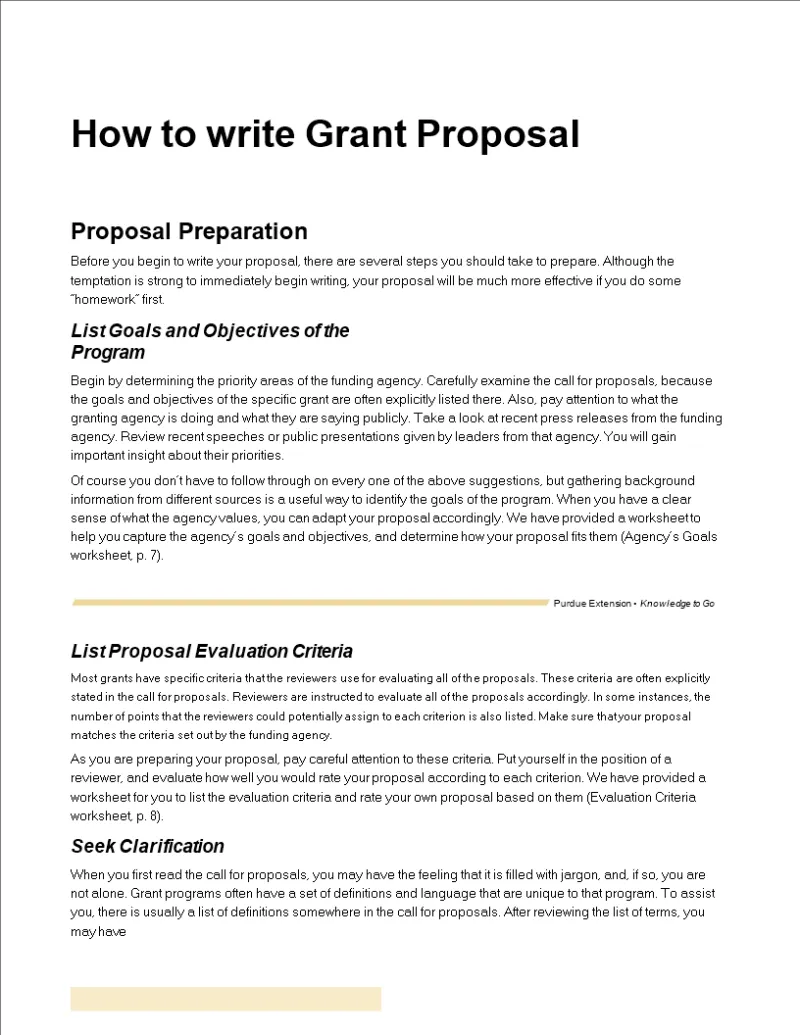
Photo: grant proposal review business documents desk professional, via www.bizzlibrary.com
Every year, thousands of organizations invest significant time crafting grant proposals that never receive a fair reading. Not because the programs lack merit, but because the proposals themselves communicate the wrong message before reviewers ever encounter the actual content. Program officers at major foundations and federal agencies consistently describe a phenomenon they call "the thirty-second filter" — an almost involuntary assessment that happens the moment they open a new application.
Understanding what triggers that filter, and how to avoid it, is one of the most consequential skills any grant writer can develop.
The First Impression Problem
Grant reviewers are not adversaries. They are professionals under significant time pressure, tasked with evaluating dozens — sometimes hundreds — of applications against a defined set of criteria. When a proposal opens with a vague, sweeping statement such as "Our organization is dedicated to making the world a better place," it signals immediately that the applicant has not done the work of connecting their mission to the funder's specific priorities.
Program officers at community foundations and federal agencies have noted, in surveys and published program guidance, that proposals failing to demonstrate funder alignment within the first paragraph rarely recover regardless of what follows. The opening lines of any proposal function as a handshake. A weak handshake rarely leads to a productive meeting.
The fix is straightforward but requires discipline: open every proposal by mirroring the language of the funding opportunity itself. Reference the funder's stated goals. Name the specific program or initiative you are responding to. Demonstrate, in concrete terms, that your organization has read and understood what the funder is actually trying to accomplish.
Formatting That Signals Disorganization
Beyond the opening paragraph, reviewers report that visual and structural choices communicate competence before a single sentence is fully processed. Common formatting red flags include:
Inconsistent font usage. Proposals that mix typefaces, vary heading sizes arbitrarily, or use colored text in unusual ways suggest a document assembled in haste rather than composed with intention.
Dense, unbroken paragraphs. Federal reviewers in particular operate under strict time constraints. Walls of text — even well-written text — force reviewers to work harder than necessary. Strategic use of bullet points, numbered lists, and white space is not a stylistic preference; it is a courtesy to the reader.
Misaligned page margins and inconsistent spacing. These details may seem minor, but they register subconsciously. A proposal that looks professionally formatted communicates organizational competence. One that does not raises questions about attention to detail — a quality funders expect in organizations they are considering trusting with significant resources.
Most federal grant portals, including Grants.gov, publish explicit formatting requirements. Ignoring these requirements is not merely an aesthetic failure; it can disqualify an application outright.
Language That Undermines Credibility
Certain phrases appear so frequently in unsuccessful proposals that experienced reviewers have developed reflexive skepticism toward them. Phrases such as "unique and innovative," "holistic approach," and "evidence-based programming" have been used so broadly that they have lost meaningful content. When a proposal relies on these terms without providing specific evidence, it reads as filler rather than substance.
Consider the difference between these two statements:
- "Our innovative, evidence-based curriculum has transformed the lives of at-risk youth in our community."
- "Our curriculum, developed in partnership with the University of Michigan's School of Education and piloted across three Detroit-area schools, reduced chronic absenteeism by 22 percent over two academic years."
The second statement requires no adjectives because the data speaks. Specificity is the antidote to vague language, and funders recognize its presence — or absence — immediately.
Similarly, passive voice construction throughout a proposal can create a sense of distance and uncertainty. "Programs will be implemented" is less compelling than "Our program director will launch the first cohort in January." Active voice signals accountability and organizational clarity.
The Budget Disconnect
One of the most frequently cited reasons for early proposal abandonment is a mismatch between the narrative and the budget. Reviewers are trained to cross-reference these two sections, and discrepancies — line items that appear in the budget but receive no narrative justification, or programmatic activities described in the narrative that have no corresponding budget allocation — raise immediate concerns about organizational financial management.
A proposal that requests $150,000 but provides a budget narrative of three sentences is communicating, unintentionally, that the applicant does not understand how funders evaluate financial stewardship. Every budget line should tell a story that the narrative supports.
Ignoring the Review Criteria
Perhaps the single most common and most preventable red flag is a proposal that fails to address the published review criteria in a structured way. Most federal opportunities and many private foundations publish explicit scoring rubrics. A proposal that does not organize its content to mirror those criteria forces reviewers to search for answers — and busy reviewers do not search for long.
Before writing a single word of narrative, experienced grant professionals map every section of their proposal to the corresponding review criterion. This practice, sometimes called a "compliance matrix," ensures that no scored element is overlooked and that reviewers can find exactly what they need without effort.
Building Proposals That Command Attention
The organizations that consistently secure competitive grants are not necessarily those with the largest budgets or the most prominent reputations. They are organizations whose proposals communicate professionalism, specificity, and genuine alignment with funder priorities from the very first line.
Avoiding the red flags described here is not about gaming the system. It is about respecting the process — and the reviewers who participate in it. When a proposal is clear, well-organized, and precisely targeted, it does not need to overcome the thirty-second filter. It passes through it.
The investment required to produce that quality of proposal is substantial. But it is considerably smaller than the cost of submitting applications that never receive the consideration they deserve.